Health Update - Months 16–19 Catch-Up
Posted by Mira on October 6, 2026 in stories
I missed a few monthly health updates over the summer due to extensive traveling across Europe, Africa, and Asia (and finally settling back in). Now that I've completed my annual checkup and comprehensive lab work this October, it's the perfect time for a multi-month catch-up!
Overall, I am very pleased with my recent report. Seeing how far my inflammatory markers have come over the past almost 2 years gives me immense gratitude and confirms that my holistic lifestyle and dietary approach is working.
I haven’t felt any tiredness in a long time. I feel like I am currently in my prime: energetic, strong, and in a shape that I’m genuinely proud of.
Contents
- Lab Results & Comparisons
- Autoimmune & ITP Update
- Sleep & Energy
- Menstrual Cycle
- Skin & Photosensitivity
- Body Weight & Composition
- What I Learned
- Next Steps
Lab Results & Comparisons
This annual checkup included a complete blood count (CBC), lipid panel, comprehensive metabolic panel, and autoimmune/inflammatory markers. Here is how my markers look today compared to previous visits.
Inflammatory Markers: ESR Dropped to 12!
The biggest highlight of this lab report is my ESR (Erythrocyte Sedimentation Rate), which measures systemic inflammation.
| Date | ESR (mm/hr) | Status / Context |
|---|---|---|
| 12/21/2024 | 34 | ER visit (Peak acute inflammation) |
| 04/23/2025 | 25 | On HCQ (Prescribed medication) |
| 07/08/2025 | 21 | Sydney (Shortly after stopping HCQ) |
| 10/01/2025 | 20 | Annual checkup 2025 |
| 12/22/2025 | 16 | PCP visit |
| 10/01/2026 | 12 🔽 | Annual checkup 2026 (Normal range: 0–20) |
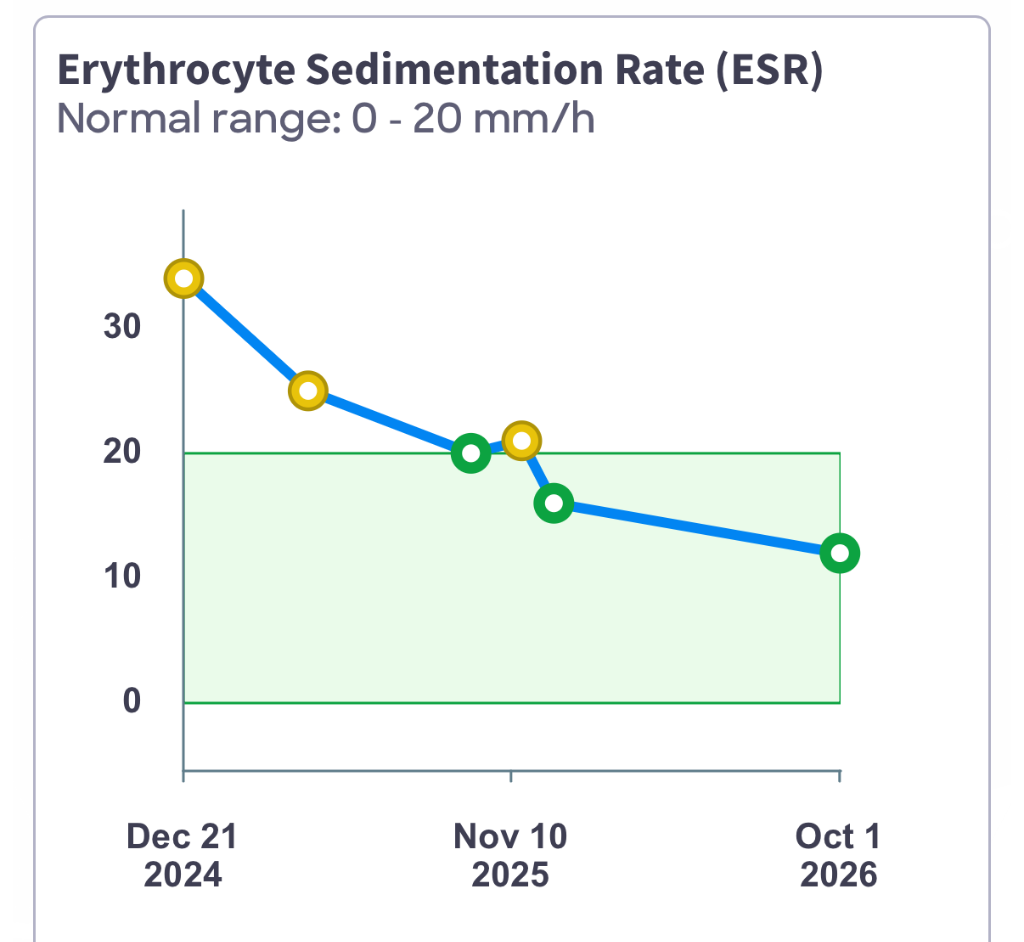 Erythrocyte Sedimentation Rate (ESR) — dropping from 34 mm/hr at diagnosis to 12 mm/hr on Oct 1, 2026.
A drop to 12 mm/hr is dramatic. When I was first diagnosed, hospitalized, and dealing with severe autoimmune flares, my ESR was 34. Even while taking HCQ in early 2025, it stayed around 25. Over the last year—completely off HCQ and managing my health through a nutrient-dense meat-based diet, sensible fasting, strength training, and stress management—my inflammation has continued to melt away.
I feel it physically, too. The persistent joint stiffness, stinging sensations, and systemic puffiness are gone. My body is genuinely healing from the inside out.
Lipid Panel & Lipid Homeostasis
Here is a side-by-side comparison of my lipid numbers over the past year:
| Metric | 10/01/2025 | 12/22/2025 | 03/13/2026 | 10/01/2026 |
|---|---|---|---|---|
| Total Cholesterol | 343 | 316 | 259 | 346 |
| Triglycerides | 193 | 132 | 185 | 187 |
| HDL Cholesterol | 50 | 50 | 45 | 50 |
| LDL Cholesterol | 254 | 240 | 179 | 259 |
| Trig/HDL Ratio | 3.86 | 2.64 | 4.11 | 3.74 |
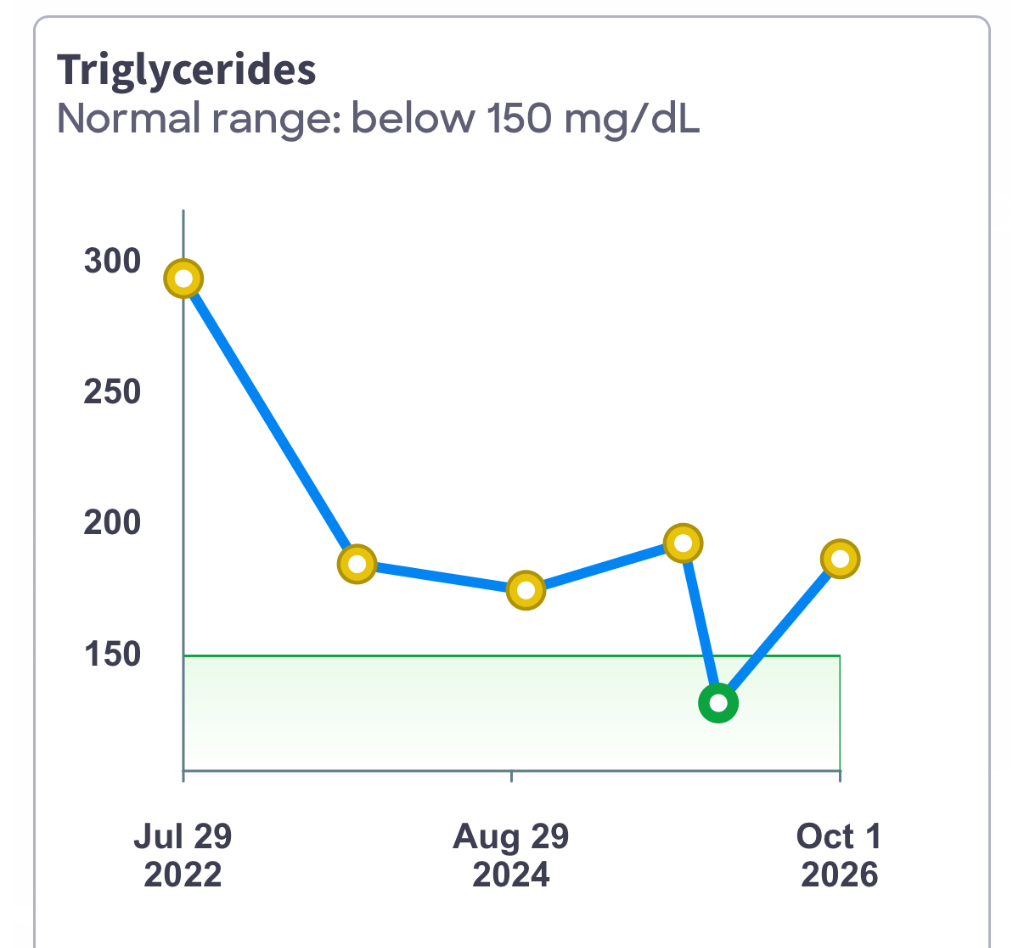 Triglycerides Over Time — showing long-term stability in the 180s on a whole-food low-carb lifestyle.
Observations on Lipids:
- LDL & Total Cholesterol: Both remain elevated (TC: 346 mg/dL, LDL: 259 mg/dL). This is consistent with a diet rich in high-quality animal fats, beef, butter, tallow, and eggs. On an animal-based low-carb template, LDL particles serve primarily as energy-delivery vehicles (carrying triglycerides and fat-soluble nutrients to peripheral tissues).
- HDL Cholesterol: Held completely solid at 50 mg/dL, remaining stable across tests.
- Triglycerides: Came in at 187 mg/dL. Over the past several months, I added whole-food carbohydrates back into my meals—such as vegetables, seasonal fruits, corn, and sweet potatoes (with zero refined seed oils or refined sugars). Despite these dietary additions, my triglycerides have stayed fairly consistently in the 180s.
Looking at the multi-year trend, I've realized that this range appears to represent my body's current triglyceride homeostasis. Rather than stressing over short-term fluctuations, I recognize that my body utilizes fatty acids and circulating lipids efficiently for fuel, especially alongside regular strength training.
Rethinking "Normal Ranges": Sex Differences and Dynamic Rhythms
Over time, I have gradually come to believe that conventional "normal ranges" defined by doctors and medical associations often miss the mark—especially for women. Most standard reference intervals make two fundamental flaws: they ignore biological sex differences, and they treat dynamic living bodies as static snapshots.
1. Biological Sex Differences (Men vs. Women)
- Different Energy Priorities (Physical Strength vs. Reproduction): Men and women evolved to utilize energy for fundamentally different biological roles. A male body is primarily wired for physical strength, explosive output, and maintaining lean mass. A female physiology, by contrast, is exquisitely tuned for reproductive vitality, nutrient conservation, and life-bearing. Because female biology must constantly protect hormone synthesis and energy reserves for potential pregnancy, our bodies handle and store circulating energy (including lipids and triglycerides) in a fundamentally different way.
- Hormone Architecture (1 vs. 3 Sex Hormones): Men operate primarily on one dominant sex hormone (testosterone) on a predictable 24-hour loop. Women, however, are governed by three major sex hormones (estrogen, progesterone, and testosterone) cycling dynamically throughout the month. Applying the same generic "normal ranges" to both sexes makes little biological sense when our underlying hormonal engines are so different.
2. Dynamic Biological Rhythms (Time of Day & Cycle Phase)
- Diurnal Rhythms (Ignoring Time of Day): Standard reference ranges treat the body as a static snapshot, ignoring circadian rhythms. For instance, my white blood cell count (WBC) has tested "abnormally low" in the 2s during morning blood draws all my life, but consistently tests completely normal in the 5s during the afternoon. Judged purely by a morning draw against a rigid static bracket, it would be misclassified as a deficiency.
- Monthly Infradian Rhythms (The Menstrual Cycle): A woman's circulating lipids naturally shift across her cycle as estrogen and progesterone fluctuate between the follicular, ovulatory, and luteal phases. A single isolated blood draw cannot capture this living, cyclical rhythm.
Understanding these differences has given me the confidence to look at my lab results holistically, in the context of how I actually feel, rather than being bound to rigid, one-size-fits-all reference intervals.
Metabolic Panel: Fasting Glucose
- Fasting Glucose: 80 mg/dL
My fasting blood sugar has remained exceptionally steady and well within the optimal metabolic zone (typically 70–85 mg/dL). This confirms stable insulin sensitivity, steady baseline energy throughout the day, and zero blood sugar crashes.
Autoimmune & Complement Markers
I also re-checked my lupus and autoimmune panel to monitor how my immune system is behaving:
| Marker | 10/01/2025 | 12/22/2025 | 10/01/2026 | Standard Normal Range | Trend |
|---|---|---|---|---|---|
| dsDNA | 22 | 22 | 21 | < 4 IU/mL | Stable / Low 📉 |
| Complement C3 | 69 | 65 | 72 | 90–180 mg/dL | Recovering 📈 |
| Complement C4 | 13 | 11 | 11 | 10–40 mg/dL | Stable (Normal) ➖ |
| CRP (hs-CRP) | <0.3 | <0.3 | <0.3 | < 0.5 mg/dL | Optimal ➖ |
- dsDNA (21 IU/mL): Remained stable at 21, down significantly from my initial 32 at diagnosis.
- Complement C3 (72 mg/dL): C3 has ticked back up from 65 to 72, showing a gradual restorative trend toward the standard reference range.
- Complement C4 (11 mg/dL): Safely in the normal reference bracket.
- hs-CRP (<0.3 mg/dL): Minimal acute inflammatory response.
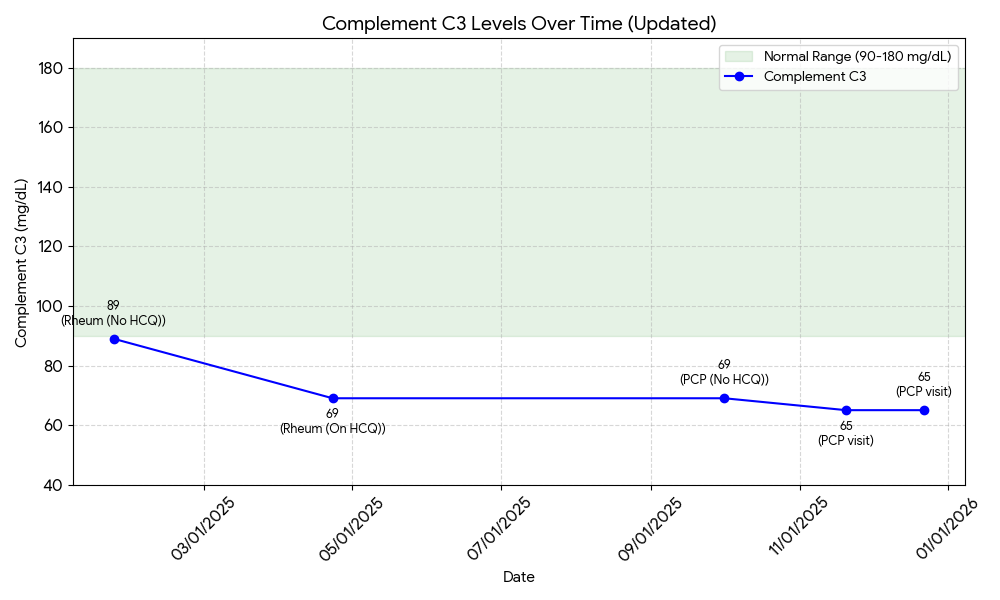 Complement C3 — steadily recovering up toward the normal range.
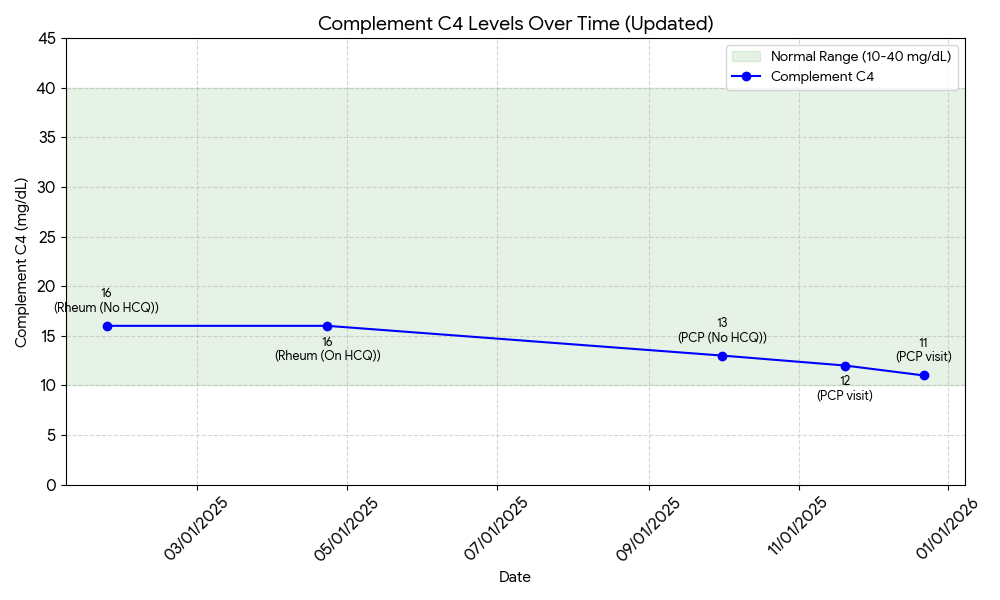 Complement C4 — stable within the standard normal reference bracket.
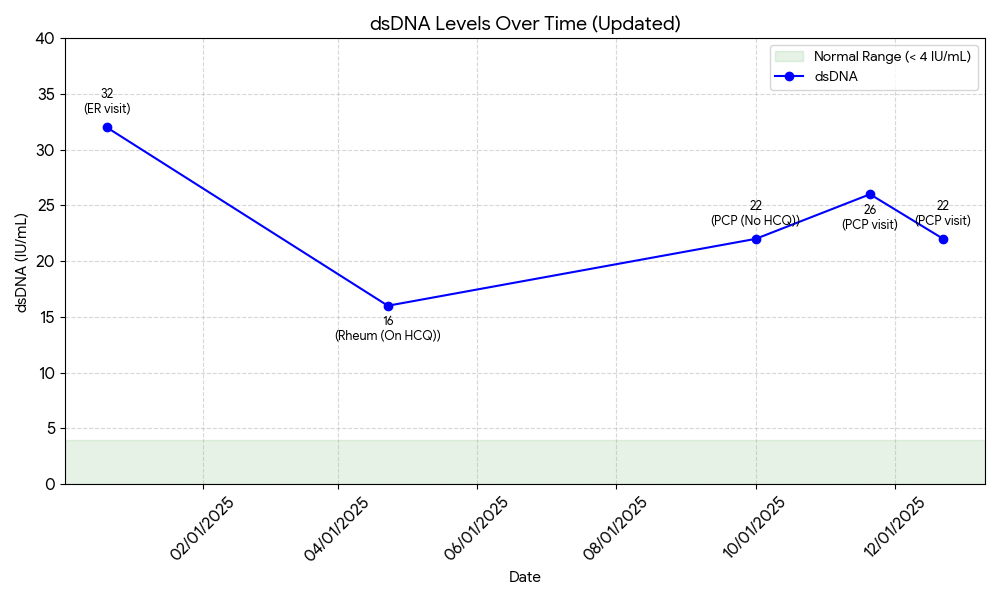 dsDNA Levels Over Time — trending down from 32 to 21 IU/mL.
Autoimmune & ITP Update
Platelet Trends & Doptelet Stability
Here is how my platelet counts have evolved over recent months:
- May 14 & 21, 2026: 30k (Doptelet dosage had been tapered too low; immediately up-dosed back to 20mg every 3 days)
- June 17, 2026: 92k (Blood draw in Barcelona — bone marrow responded strongly to 20mg every 3 days)
- August 25, 2026: 51k (When I did this test, I had a sore throat, so I suspect this dip was due to a mild infection)
- October 01, 2026: 107k (Annual checkup — back comfortably into the 100k+ safe zone!)
I feel truly blessed to see 107k. Looking back at my history, the last time I was around this level (107k on 08/06/2025), I was taking Doptelet at 20mg every 2 days (or alternating 2|2|3 days). Being able to reach 107k now on 20mg once every 3 days is significant progress!
This tells me the current dosage is safe and reliable: even when fighting a mild infection, 51k was safe enough to prevent any bleeding issues, and 107k provides an adequate, reassuring buffer.
Sleep & Energy
I haven’t felt any tiredness in a long time. My daytime energy is sustained and high from morning to evening.
Sleep has been generally good and restorative since returning from our travels across Europe, Africa, and Asia. During international travel, changing time zones occasionally caused lighter sleep, but grounding myself with morning light helped me adjust quickly.
Recently, when I caught a mild cold, both my husband and I found it harder to sleep. Other than during occasional minor sickness, my sleep quality has remained solid.
Menstrual Cycle
My menstrual cycles across Months 16–19 have returned to my pre-ITP diagnosis / healthy baseline: short, predictable, and very manageable! After the up-dose back to 20mg every 3 days, I have not had any scary, uncontrolled bleeding episodes or need for TXA.
Key practices that keep my cycle smooth and aligned with my body's natural rhythms:
- Follicular phase power: During the follicular phase of every cycle (the ~5-day window before ovulation), I train harder, fast hard, and lean into that natural surge of energy. I tell myself: this is the time when my body is the most powerful, resilient, and forgivable.
- Luteal phase softening: Easing up on fasting during the late luteal phase right before menstruation to support progesterone and hormone balance.
- Bleeding days care: Avoiding heavy lifting or intense strain during the first 2–3 days of bleeding; sticking to gentle walks and stretching instead.
- Peace of mind: Trusting my body and staying calm rather than panicking over minor clotting.
Skin & Photosensitivity
My skin has been remarkably calm, clear, and resilient. Even with intense summer sun exposure during our travels—including visiting the Sahara Desert without using any sunscreen—I experienced absolutely zero sunburn. Best of all, I don't feel photosensitivity or stinging sensations in the sun anymore, and there has been zero lupus butterfly rash, coinciding with the drop in my systemic inflammation (ESR down to 12).
Body Weight & Composition
During my summer travels, I lost tons of weight. With lots of active walking and mindful eating ("fork down"), my cycle average dropped from around 127 lbs in May down to below 120 lbs by mid-summer.
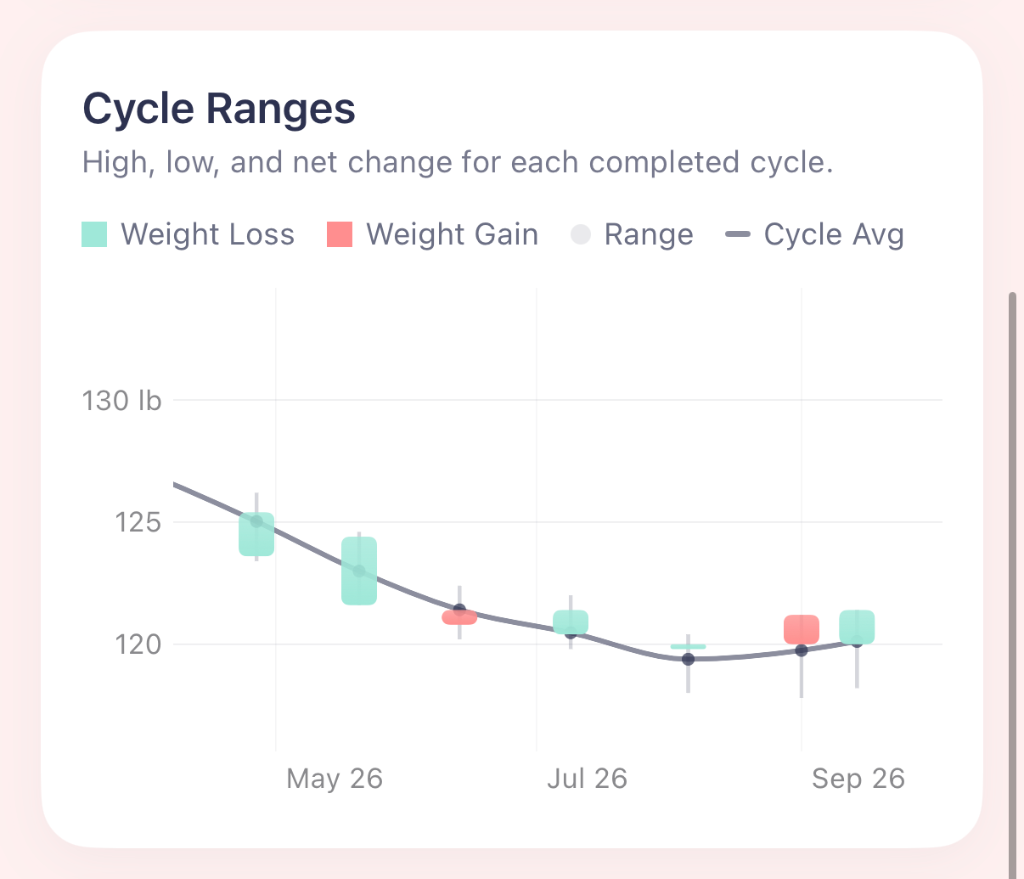 Cycle-by-cycle weight ranges in HerWeigh, showing the steady weight drop during traveling months and stabilization as muscle training began.
One crucial lesson I learned along the way is that whenever you lose weight, a percentage of that loss is inevitably muscle, not just fat. That realization led me to develop a seasonal strategy that works naturally with my lifestyle:
- During traveling months: "Fork down" and shrink the fat.
- At home: Consistent weight training to preserve, rebuild, and bulk up lean muscle.
About two months ago, after settling back home, I shifted my full focus to building lean muscle. My primary goal is to build functional muscle to be truly healthy, metabolically resilient, and strong for life. At the same time, I also embrace my secondary goal: I want to look toned and sexy, which makes me feel genuinely confident and proud of the body I've worked so hard to heal!
As I started training consistently, I noticed my scale weight ticking up slightly (hovering around 120 lbs). To ensure this was predominantly clean muscle accretion rather than excess fat, I tracked my cycle-by-cycle rate of change in HerWeigh.
My current monthly weight gain is +0.31%, which is well within the clean lean gain benchmark (<0.5%/month). It is deeply reassuring to see that my body is gaining functional tissue while keeping body fat and metabolic health in check.
 Building lean muscle tone and strength through consistent, intuitive weight training.
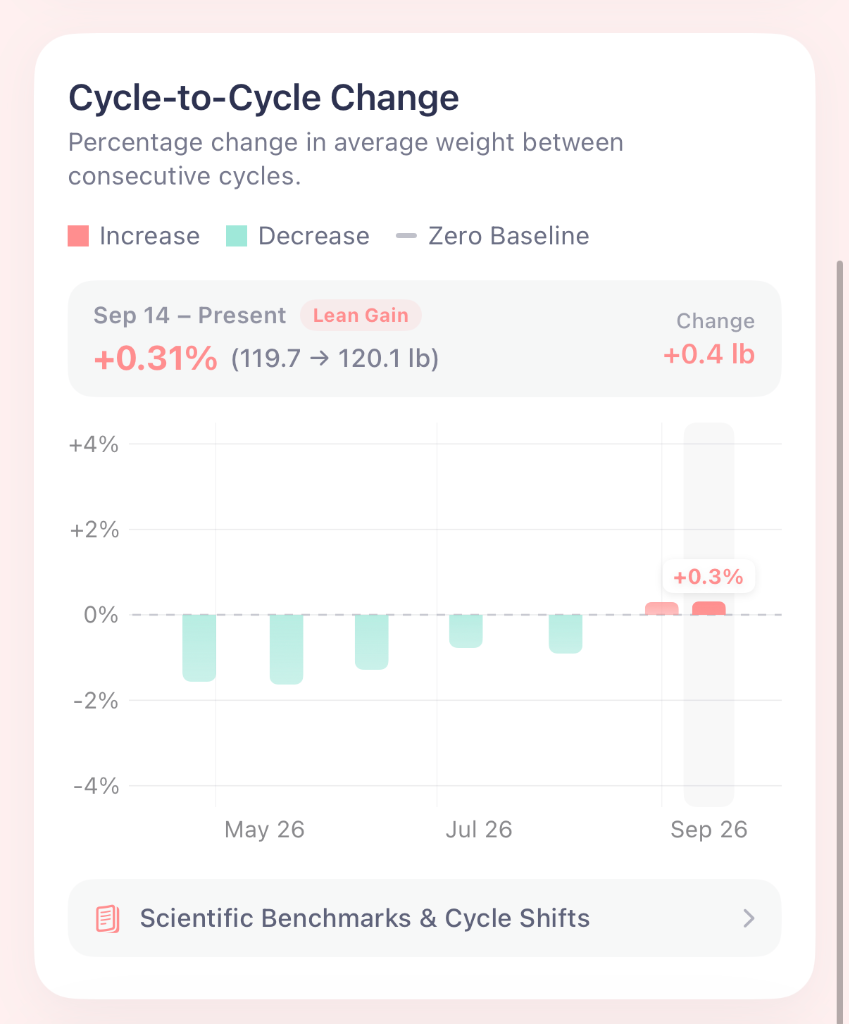 Tracking monthly percentage weight change in HerWeigh to confirm clean lean gain (+0.31% / <0.5% per month).
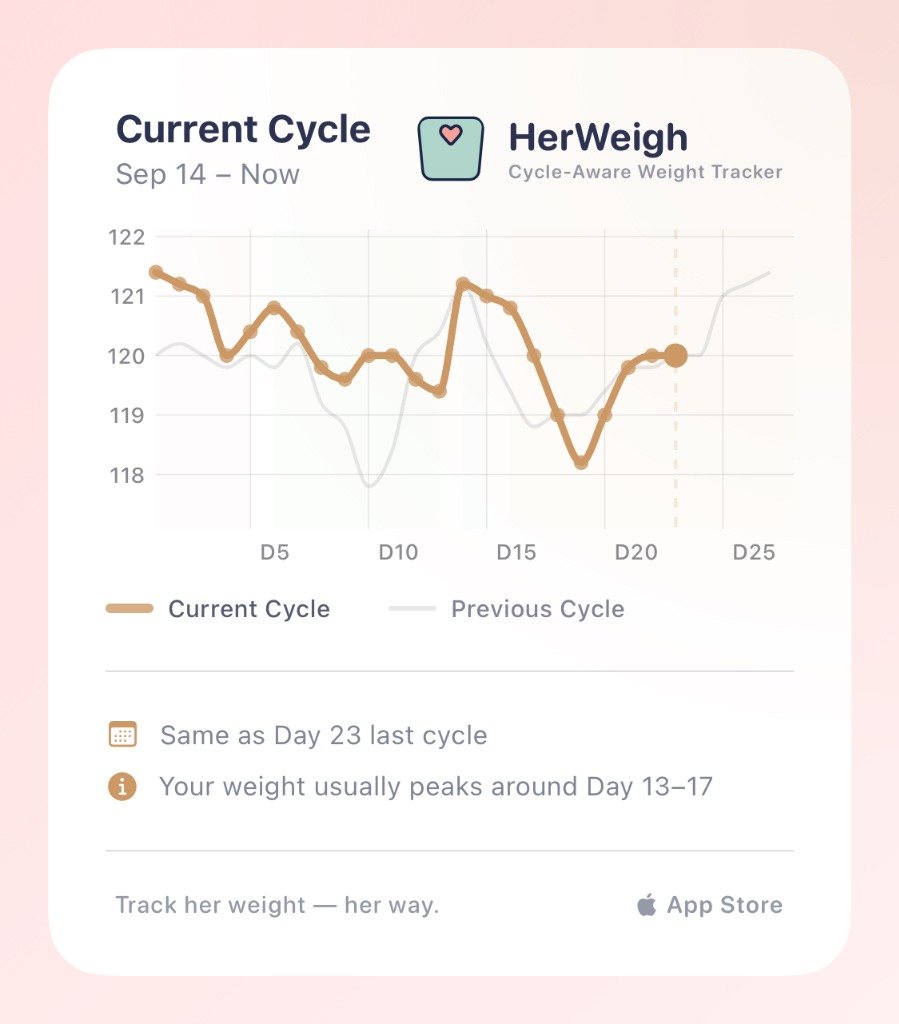 Tracking cycle-by-cycle weight patterns and day-to-day fluctuations in HerWeigh.
What I Learned
1. Training Is Stimulation, Not Torture
I completely revamped my training philosophy over the past two months. I used to train 3–4 times a week with scheduled rest days in between, sometimes pushing heavy weights. Now, I go to the gym almost every day—as long as my body feels good and I feel pumped to go. Instead of lifting heavy, I only use lighter weights and do enough controlled reps until I feel my form start to change, and then I stop.
This approach has been a game changer:
- No chronic soreness: I don't wake up feeling beat up every morning.
- Injury prevention: Joint strain is virtually zero.
- Better sleep: My sleep has been deep and restorative without excessive nervous system fatigue.
- Visible changes: My body composition and muscle tone are improving steadily over time.
I now believe this is truly how training is supposed to be. Your body doesn't love to be shocked, and you shouldn't have to torture your body in the gym to make progress. By treating exercise as gentle stimulation rather than punishment, recovery stays effortless and progress happens naturally.
2. The Science of the Lean Gain Benchmark
I’ve always known that muscle is denser and heavier than fat, but when the scale started going up, I realized I didn't know what rate of weight gain was actually acceptable and realistic for natural muscle growth. I didn't want to blindly gain weight without knowing if it was fat or muscle, so I did some digging into the research.
What I found is that for women engaging in natural resistance training, a monthly weight gain of around 0.25% to 0.5% of body weight is the physiological sweet spot for clean, lean muscle accretion without accumulating unnecessary fat. Knowing this specific benchmark gave me immense clarity, confidence, and peace of mind when tracking my scale weight.
3. Grains & Flours: Staying Away from Rice and Flour
During my travels in Spain, we had limited food options right after arriving before getting settled into our routine. I ate some rice with my meals, and almost immediately, I noticed my weight started to balloon.
This was a very clear observation. When I eat other whole-food carbohydrates like sweet potatoes, corn, or fresh fruit, my weight and fluid balance remain steady. But rice causes an immediate, noticeable spike in water retention and scale weight for my body.
Because of these insights, I now stay away from both rice and flour:
- Rice: Due to the immediate, sharp spike in water retention and weight gain.
- Flour: Due to its highly refined nature and uncertain impact on my immune system (which I will need to test out very carefully and cautiously down the road).
It was a helpful reminder that not all carbohydrates behave the same way in my system—whole-food roots and fruits suit my metabolism and immune health far better than grains and refined flours.
4. Rethinking Bras: Social Expectations vs. Natural Health
While traveling in Barcelona, I noticed that many women comfortably went without bras in their day-to-day lives. Seeing that made me pause and rethink why we wear them in the first place.
For so long, women are taught to wear bras automatically, but I’ve realized that wearing one is largely a social norm rather than something that promotes true physical health. Restrictive bras can compress tissues and restrict natural lymphatic drainage and ribcage expansion (an area I want to research even more deeply).
Since that trip, I have stopped wearing bras most of the time. The physical comfort and freedom on my body have been wonderful—and on a side note, I also think going braless looks sexy, natural, and confident! Nowadays, I only wear one for more formal or serious settings (such as church or school activities). It’s another small but empowering way to let my body be in its natural state.
5. Why I Stopped Wearing Yoga Pants
For very similar reasons, I completely stopped wearing yoga pants.
Tight, suffocating, compressive activewear has become a universal uniform, but it constricts natural circulation. Once you understand the evolutionary and hormonal reasons why women naturally carry thicker thighs and arms, you will never feel shamed about your body.
Yoga pants suck. Wear short shorts, let your legs breathe, and feel confident in your own skin!
6. Heat Stroke & Core Temperature: Hydration Isn't Everything
In September, I had an intense bout of heat stroke while picking jujubes out in the direct sun. It caught me by surprise—the last time I had heat stroke was all the way back in middle school!
What surprised me most was that I had plenty of water and electrolytes with me and made sure to stay hydrated. But it was an eye-opening reminder that hydration alone isn't enough: when intense, radiant sun heat builds up faster than your body can dissipate it, your core temperature rises regardless. Direct sun exposure and internal body temperature matter just as much as fluid intake, and listening to early signals to get into the shade is non-negotiable.
Next Steps
ITP & Medication
- Maintain Doptelet at 20mg every 3 days to keep platelets stably in the 100k+ safety zone.
- Continue strictly avoiding gluten.
Diet & Nutrition
- Keep animal protein (beef, lamb, fish, eggs) as the centerpiece of every meal.
- Continue enjoying whole-food carbs (sweet potatoes, squash, fruits, corn) while strictly staying away from rice, flours, and refined seed oils.
- Align eating windows with cycle phases (more relaxed around the luteal phase).
Fitness & Lifestyle
- Maintain intuitive, frequent light-weight workouts (focusing on form and stopping before fatigue breaks technique).
- Prioritize daily outdoor walks and natural morning light.
- Protect 8 hours of restorative sleep each night.