
In the past year, because I wanted to lose some weight, I started weighing myself every day. And in the process, I learned much more about my body than I expected.
I weighed myself every morning, under roughly the same conditions, because I wanted to capture my lowest weight of the day and, more importantly, create a consistent dataset.
After a year of doing this, I started seeing patterns.
The biggest learning is this: A woman's body weight has a cycle of its own.
Weight fluctuates throughout the menstrual cycle. It is not linear. And many of the changes you see on the scale from one day to the next have little to do with gaining or losing body fat. So if the scale says you gained one pound today, don't get discouraged. And if it says you lost one pound tomorrow, don't get overly excited either.
Your body is much more sophisticated than a number on a scale.
Here are the patterns I found.
Contents
- How My Menstrual Cycle Affects the Scale
- Things Other Than Your Cycle Can Move the Scale
- The Tool I Used: HerWeigh
- Research & References
How My Menstrual Cycle Affects the Scale
Right After My Period, I May Lose Weight
Before my period, I may gain some weight. Then, once bleeding starts and the cycle resets, I often see the scale move down again.
This makes physiological sense. Sex hormones influence the body's systems for regulating water and sodium. Estrogen can influence thirst and the hormone arginine vasopressin (AVP), which regulates water balance, while progesterone also interacts with the systems that regulate sodium and water.
Research tracking women across hundreds of menstrual cycles has found that perceived fluid retention changes across the cycle and is particularly pronounced around menstruation. Another study found that body weight during menstruation was about 0.45 kg (1 lb) higher than during the first week of the cycle, largely explained by an increase in extracellular water—not an increase in body fat.
For me, this can show up as a surprisingly fast drop in weight during the first few days of my period.
2–3 Days Before Ovulation, My Weight Tends to Rise Quickly
This is one of the most interesting patterns I discovered.
In the 2–3 days leading up to ovulation, my weight can rise very quickly—sometimes 1–2 pounds in a single day. I also find myself unusually thirsty during this period.
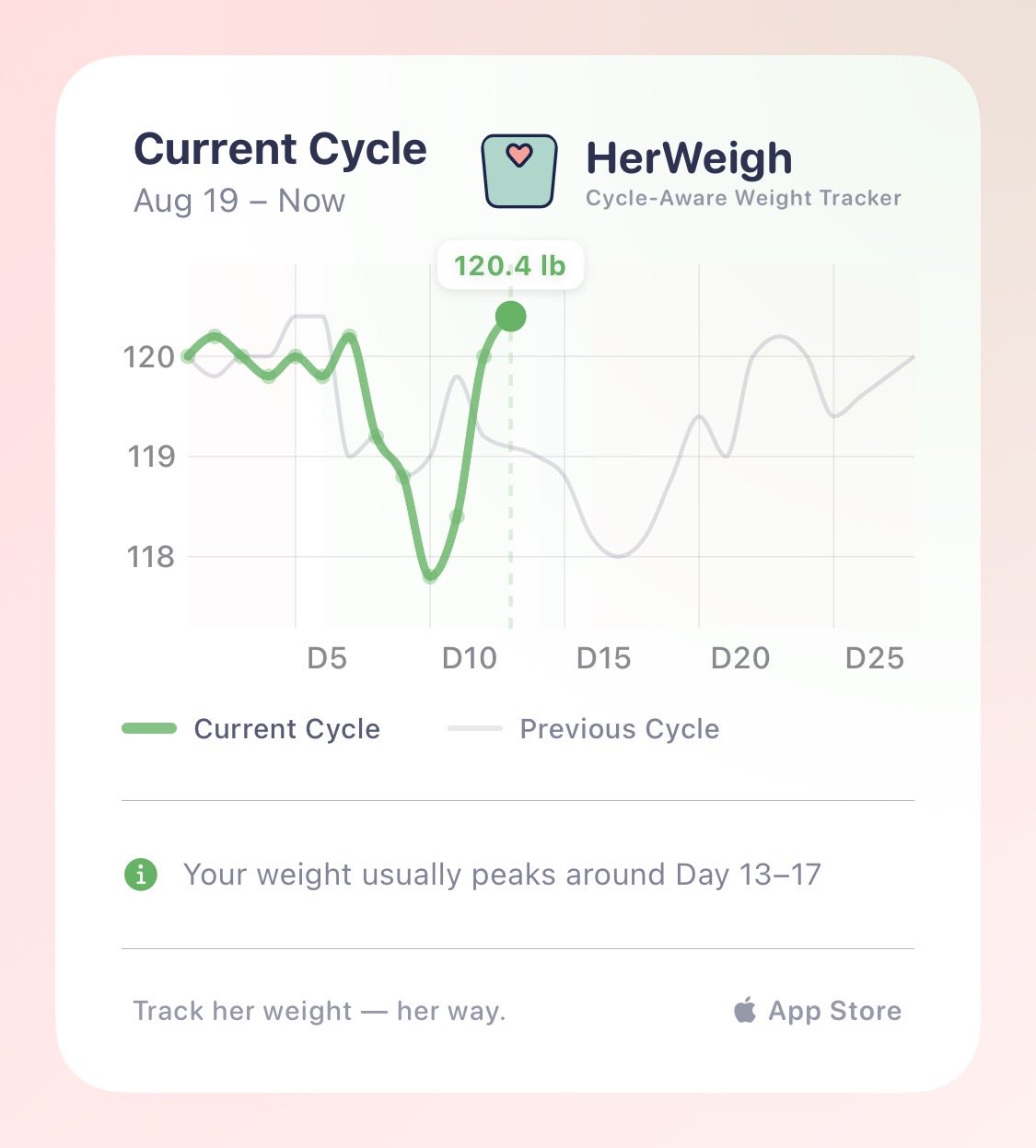 My weight increased rapidly 2-3 days before ovulation
This is the point where the menstrual cycle gets hormonally interesting.
Before ovulation, estradiol (estrogen) rises substantially as the dominant follicle develops. When estrogen reaches a sufficiently high level, it helps trigger the LH surge, which leads to ovulation. Estrogen also participates in the body's regulation of thirst and water balance and can alter the threshold at which AVP is released.
That gives me a plausible explanation for why I see a short-term increase in water weight around this time.
But there is an important caveat: the science is not as simple as “estrogen rises, therefore you retain water.”
In a one-year study of 765 menstrual cycles, researchers found that self-reported fluid retention gradually increased during the 11 days surrounding ovulation. However, they did not find a significant direct association between measured estradiol or progesterone levels and individual fluid-retention scores.
2–3 Days After Ovulation, My Weight Can Drop Quickly
Then something almost comical happens.
A few days after ovulation, I sometimes find myself needing to pee constantly during the day. And the next morning, the scale can drop dramatically. This is what I call my “whoosh day.”
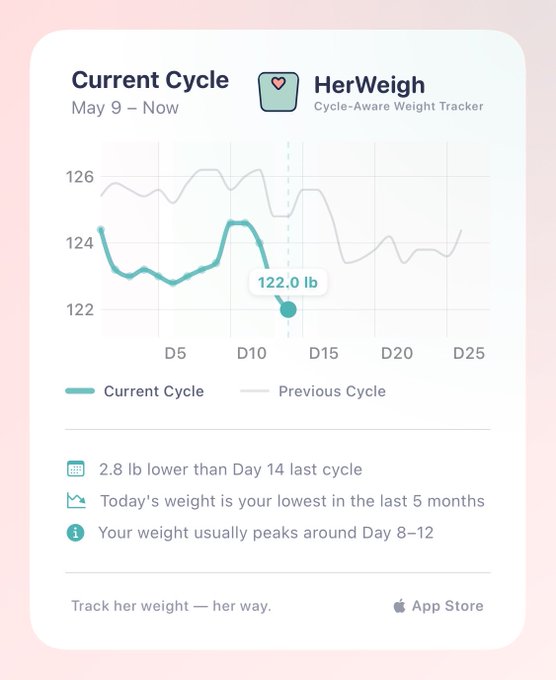 My weight dropped dramatically a few days after ovulation
The timing also makes sense from a hormonal perspective. After ovulation, the follicle that released the egg becomes the corpus luteum, and progesterone rises sharply, while estrogen has another, smaller rise. Progesterone and estrogen both interact with the systems that regulate sodium and water—including aldosterone, renin, AVP, thirst, and kidney function.
Interestingly, research on progesterone and fluid regulation suggests that progesterone can promote sodium excretion under some circumstances, while the overall effects of reproductive hormones on body-fluid regulation are complex and depend on the hormonal environment.
That is one of the patterns I would never have noticed from occasional weigh-ins.
Before My Period, I May Gain Weight Again
Then comes another familiar pattern. As I approach the next cycle, my weight may start creeping up again.
After ovulation, I enter the luteal phase, when progesterone rises and estrogen fluctuates. As the luteal phase progresses toward menstruation, both hormones eventually fall if pregnancy does not occur.
These hormonal changes can influence fluid regulation, appetite, digestion, and other physiological processes. Research shows that menstrual-cycle weight changes can be largely attributable to changes in extracellular water rather than changes in body composition.
Things Other Than Your Cycle Can Move the Scale
The menstrual cycle isn't the only thing I discovered. Once you weigh yourself every day, you start noticing that the scale reacts to all kinds of things.
Poor Sleep
When I sleep poorly, my weight may go up the next morning.
There are several possible mechanisms.
-
Sleep loss affects the hormones and systems involved in metabolism and appetite. Experimental studies have found that sleep restriction can increase evening cortisol, alter insulin sensitivity, and affect appetite-regulating hormones such as ghrelin and leptin.
-
A poor night of sleep can change eating behavior the following day—more hunger, different food choices, or different meal timing.
So a higher number on the scale after poor sleep doesn't necessarily mean I gained that amount of body fat overnight. Sometimes the scale is reflecting water, food intake, digestion, and hormonal changes, all at once.
See: Role of sleep and sleep loss in hormonal release and metabolism
Too Much Salty Food
This one is much easier to understand. When I eat a lot of salty food, my weight may jump.
Sodium affects the body's fluid balance. When sodium intake is high, the body retains additional water to maintain the appropriate concentration of sodium in body fluids. That extra water can show up quickly on the scale as increased body weight.
Too Much Exercise
This one surprised me. You would think that if exercise burns calories, exercising more should always make the scale go down. But sometimes the opposite happens.
After particularly hard workouts, my weight can go up temporarily. I often notice this together with muscle soreness and poorer sleep.
One time, I stopped weight training for several weeks and just walked. To my surprise, I started losing weight consistently and easily.
Here are the reasons:
-
Intense exercise creates a recovery response in the muscles. Exercise-related muscle damage can produce temporary swelling, and exercise also affects fluid regulation and blood volume.
-
Strenuous exercise can also stimulate hormonal systems involved in maintaining blood pressure and fluid balance.
-
Stress hormones, like cortisol, can also be elevated after intense workouts. This can affect fluid balance and lead to temporary weight fluctuations.
See: Exercise-Associated Hyponatremia
Jet Lag
Travel gives me another fascinating experiment. When I have jet lag, my weight can move very quickly in either direction. Sometimes I lose weight. Sometimes I gain it. A big part of this seems to depend on what happens to my appetite and eating schedule.
In the past year, I noticed twice, once after flying from Egypt to China, once after flying from Japan to US, my weight dropped significantly as I adjusted to the time difference. I simply did not have much appetite to eat for the first few days.
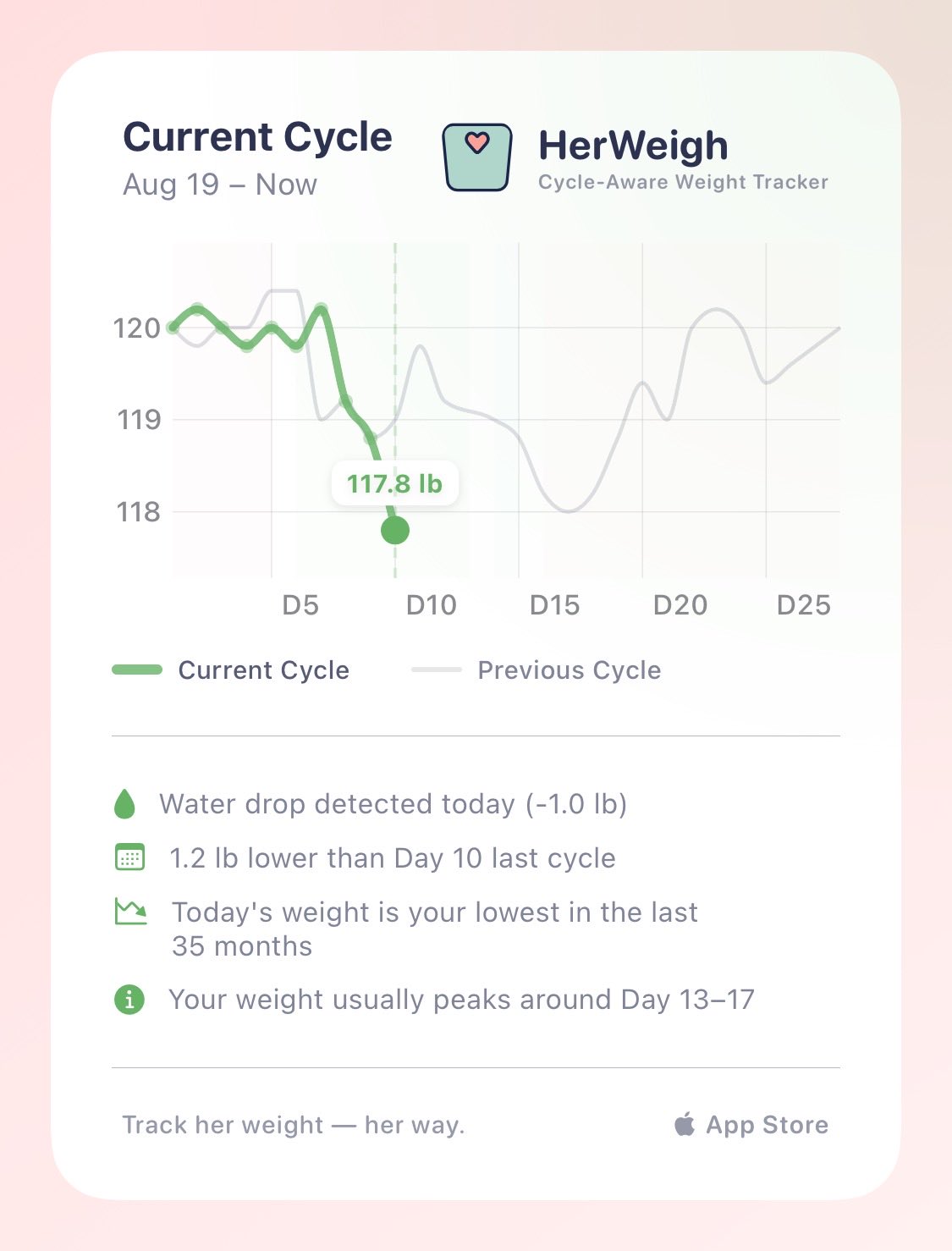 I lost weight after traveling from Japan to US.
Jet lag disrupts the body's circadian rhythm—the internal timing system that coordinates sleep, wakefulness, hormones, metabolism, and eating. Circadian misalignment can also change meal timing and energy balance.
And then there are all the secondary effects of travel:
- Different meal times
- Different foods
- Changes in appetite
- Disrupted sleep
- Dehydration
- Restaurant meals
- More or less physical activity
The scale can respond very quickly to all of these.
See: Circadian rhythms and meal timing: impact on energy balance and body weight
Sex May Affect My Weight — But I Don't Know the Mechanism Yet
This is one of my observations that I haven't been able to back up with good scientific research.
I've noticed that sex may sometimes be followed by a gain in my scale weight.
But I haven't found convincing evidence that sex itself causes a meaningful short-term increase in body weight. There are plenty of possible explanations for a correlation: hydration, food and drink, sleep, activity, timing within the menstrual cycle, or simply coincidence.
The Tool I Used: HerWeigh
I used HerWeigh to make sense of my data. It combines my weight data and menstrual-cycle data from Apple Health, making it easy to see how my weight changes from cycle to cycle.
Seeing the data this way helped me notice patterns I would have completely missed from a regular weight chart.
For instance, starting in August 2026, I started serious weight training with progressive overload. Despite eating the same, I saw my weight start to fly. On daily scale weigh-ins, it looked like I was suddenly gaining weight rapidly.
Looking at my cycle ranges in HerWeigh, I could see the bigger picture: after dropping through the summer down to around 119.5 lb, my cycle average leveled out and turned slightly upward:
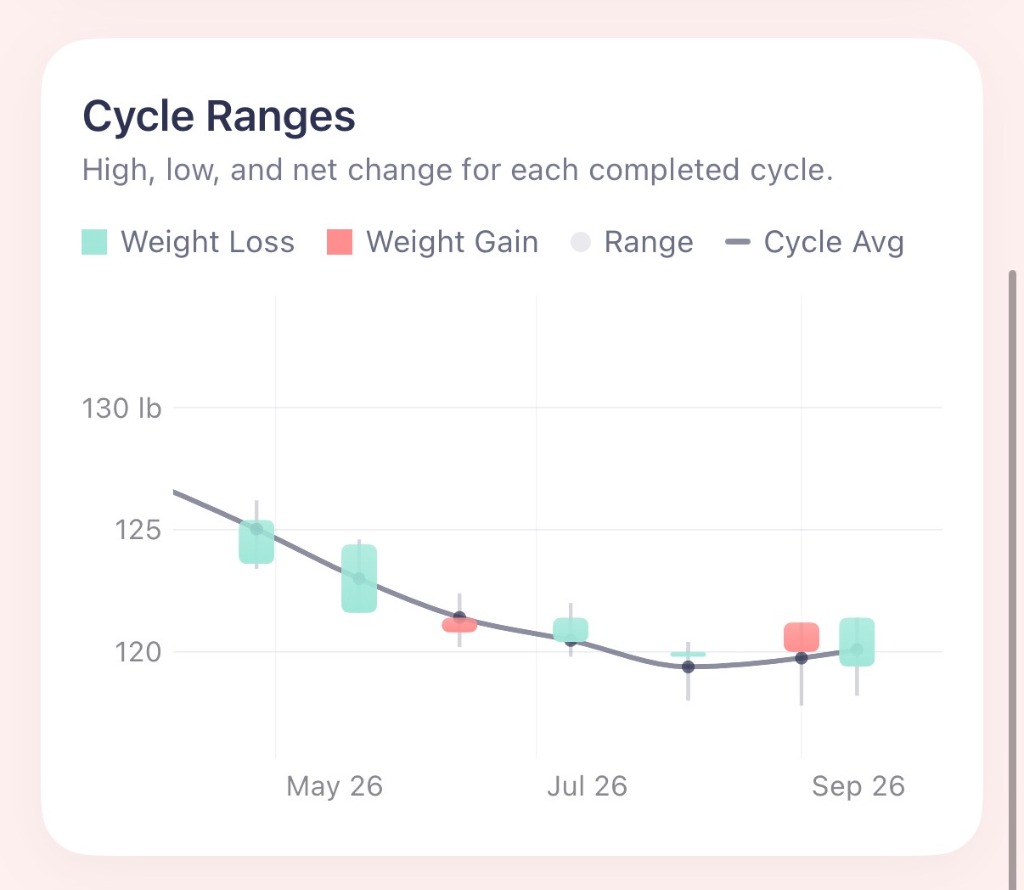 Cycle ranges and averages across consecutive cycles, showing the long-term trend leveling out and shifting into a controlled lean gain.
Then I did some research and found that within a cycle, a weight increase within 0.5% is widely considered acceptable for lean gain (muscle hypertrophy and glycogen storage rather than body fat).
When I checked HerWeigh's cycle-to-cycle change, it confirmed that my cycle average only increased by +0.28% (+0.3 lb)—comfortably within the benchmark for lean gain.
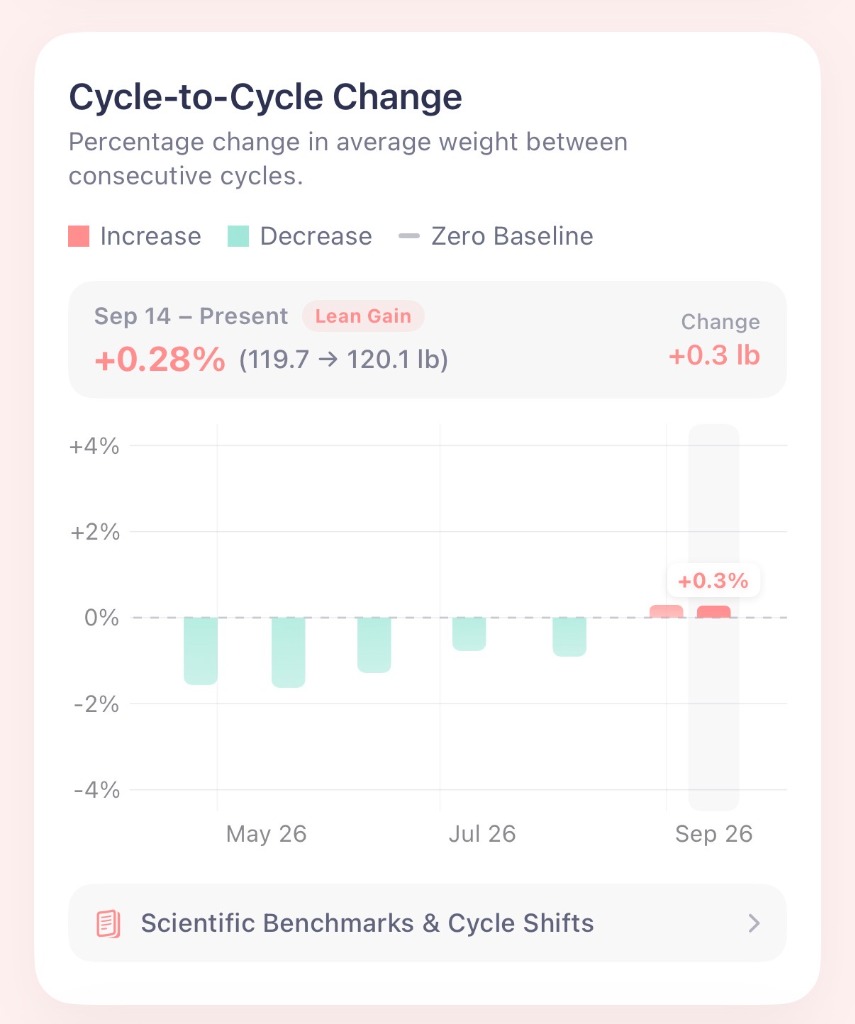 HerWeigh identified my cycle-to-cycle increase of +0.28% as a healthy "Lean Gain."
Seeing my weight in the context of my menstrual cycle rather than day-to-day noise gave me peace of mind that my progressive overload training was building lean muscle rather than fat.
Research & References
A few of the physiological explanations in this article are based on published research. My observations about how my own weight changes around ovulation, menstruation, exercise, travel, sleep, and sex are personal observations and should not be interpreted as universal patterns.
- White CP, Hitchcock CL, Vigna YM, Prior JC. Fluid Retention over the Menstrual Cycle: 1-Year Data from the Prospective Ovulation Cohort. Obstetrics and Gynecology International, 2011. PubMed
- Kanellakis S, et al. Changes in body weight and body composition during the menstrual cycle. American Journal of Human Biology, 2023. PubMed
- Stachenfeld NS. Sex Hormone Effects on Body Fluid Regulation. Exercise and Sport Sciences Reviews, 2008. PMC Full Text
- Leproult R, Van Cauter E. Role of Sleep and Sleep Loss in Hormonal Release and Metabolism. Endocrine Development, 2010. PubMed
- American Heart Association. Effects of Excess Sodium. Updated July 8, 2026. American Heart Association
- Boege HL, Bhatti MZ, St-Onge MP. Circadian rhythms and meal timing: impact on energy balance and body weight. Current Opinion in Biotechnology, 2021. PMC Full Text
- Rosner MH. Exercise-Associated Hyponatremia. American Clinical and Climatological Association, 2019. PMC Full Text
- Aragon AA, Schoenfeld BJ. Magnitude and Composition of the Energy Surplus for Maximizing Muscle Hypertrophy: Implications for Nutrition and Exercise. Strength & Conditioning Journal, 2020. PubMed

Mira (美良)
🥩 Carnivore & Gut HealthHi, I’m Mira! I healed debilitating autoimmune conditions and severe gut issues through a meat-based carnivore diet. I write about practical zero-carb meal prep, real-world healing milestones, and delicious animal-based recipes to help you regain your vitality.