

This past month, I successfully lowered my medication dose. I feel good overall, though I’ve noticed a small weight gain that I’d like to explore further.
Contents
- Body Weight
- Diet
- Gym Performance
- Walking
- Sleep
- Resting Heart Rate
- Menstrual Cycle
- Other Learnings
- Autoimmune Update
- Next Steps
Body Weight
My body weight increased by an average of 1 lb over the past month. I used HerWeigh to track my body weight, and clearly I am gaining weight.
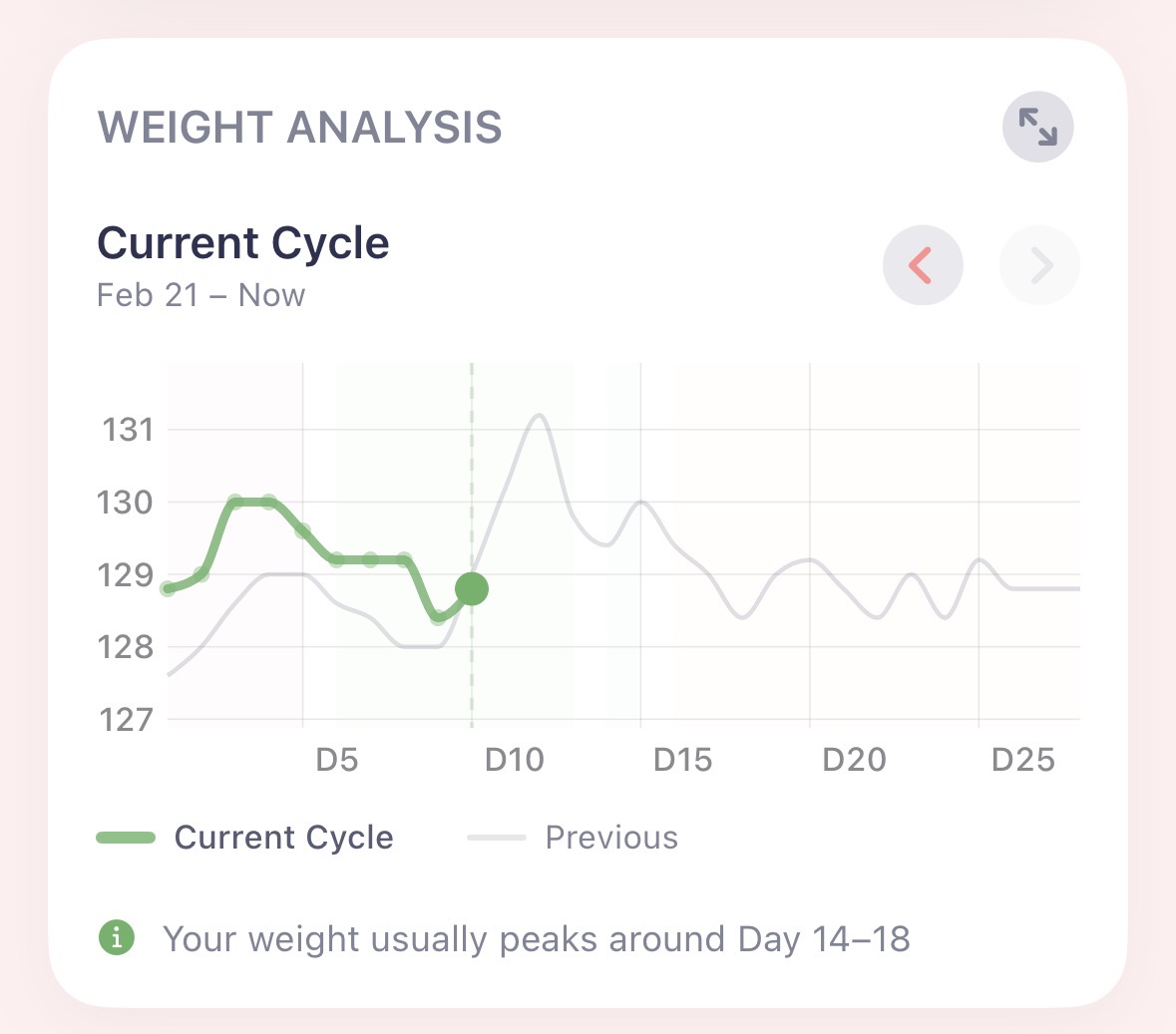 This cycle body weight: you can see the starting weight is higher than before.
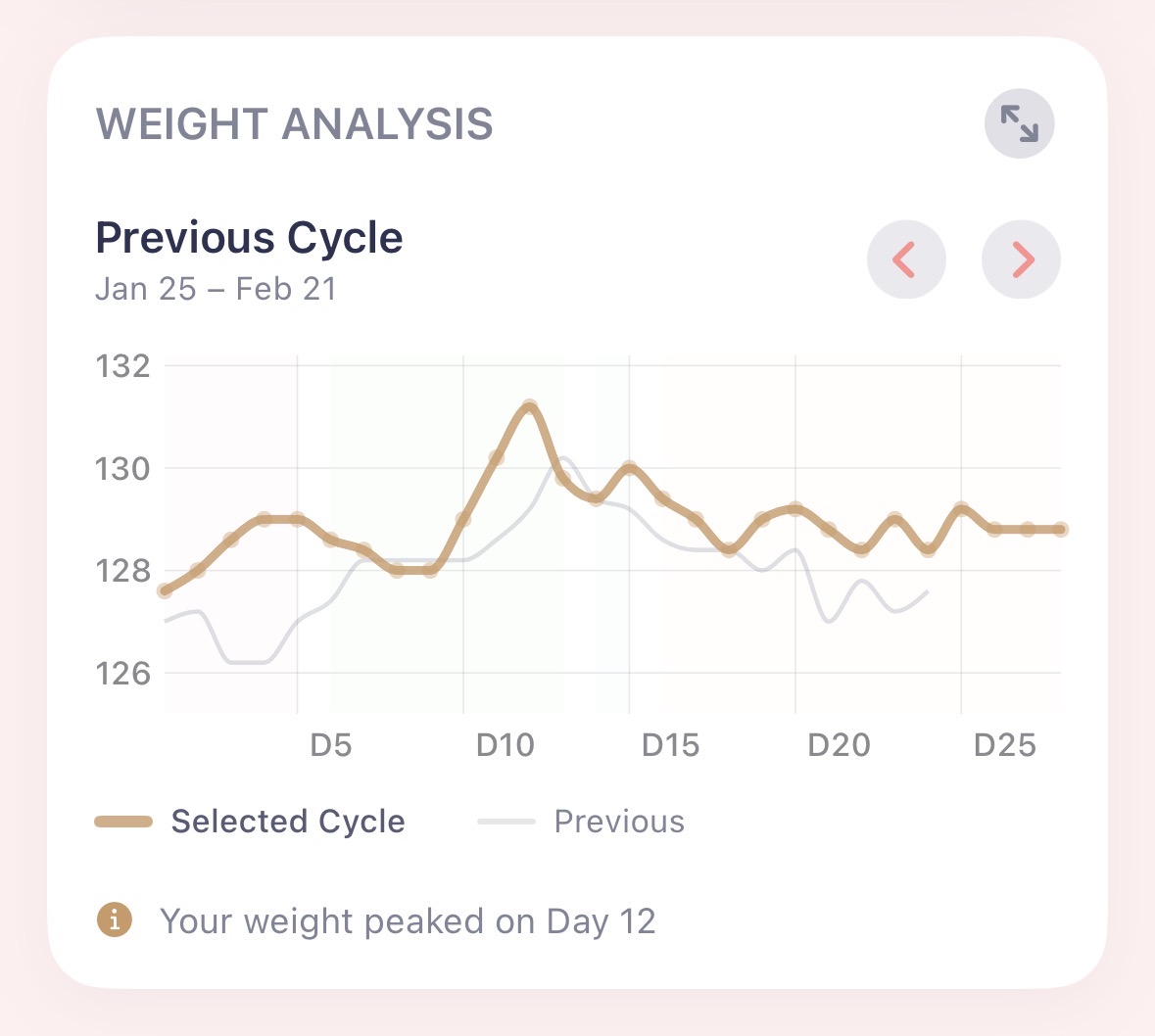 Last cycle body weight: across the entire span of the cycle, the weight is higher than the previous cycle.
I'm not sure what percentage of the weight gain is due to muscle and what percentage is due to fat. To answer this question, I may need to start tracking my waist size to understand more, since waist size tells you more about fat gain.
I did have two changes in the past month compared to the month before:
First, I stopped doing longer fasts. The average fasting time in the recent cycle is 13.4 hours, with a maximum of 14.5 hours, whereas the previous cycle (without sufficient data) averaged 14.4 hours with a maximum of 17.4 hours. The reason for this change was to improve gym performance.
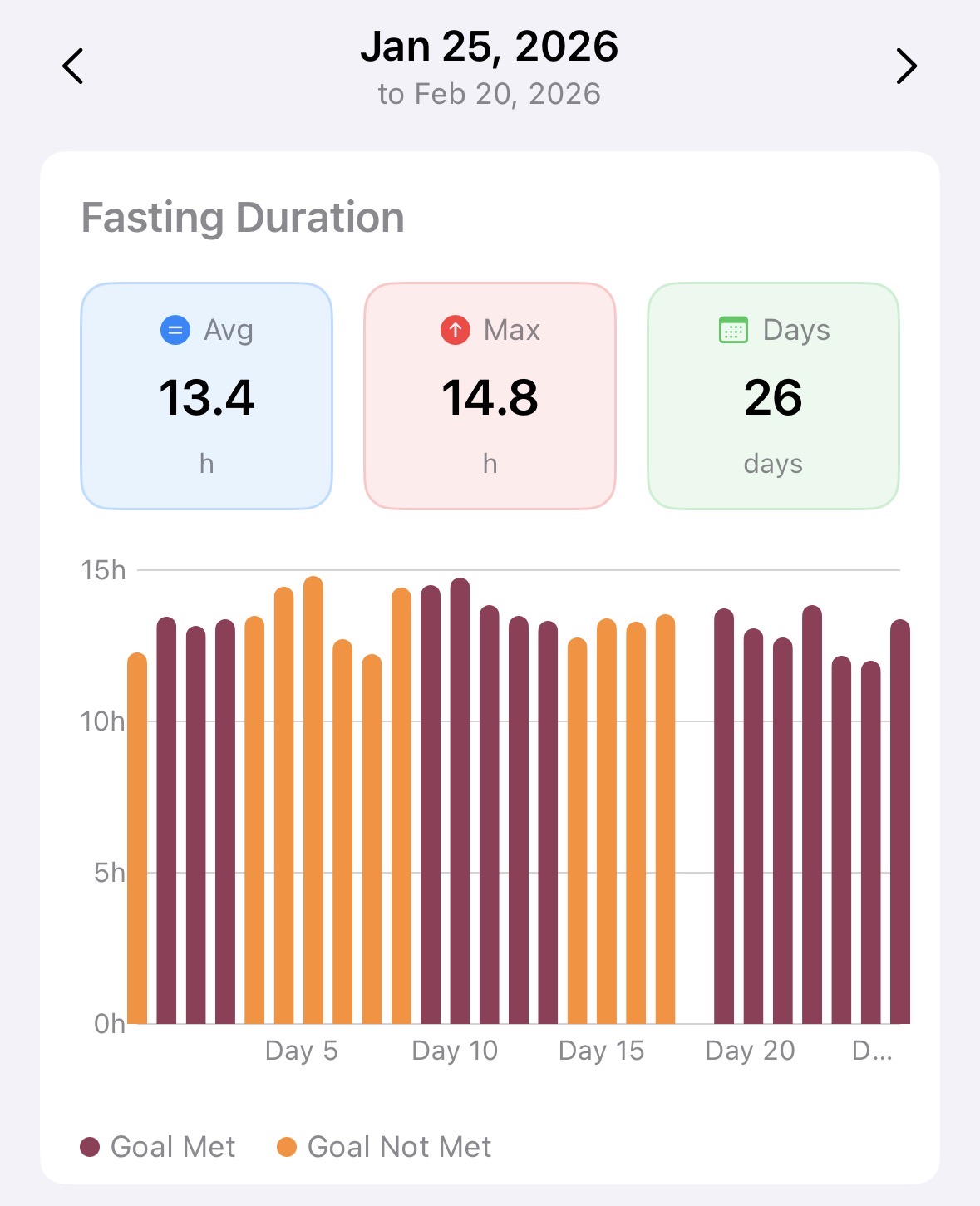 Last cycle fast: the average fasting time is 13.4 hours, with a maximum of 14.5 hours.
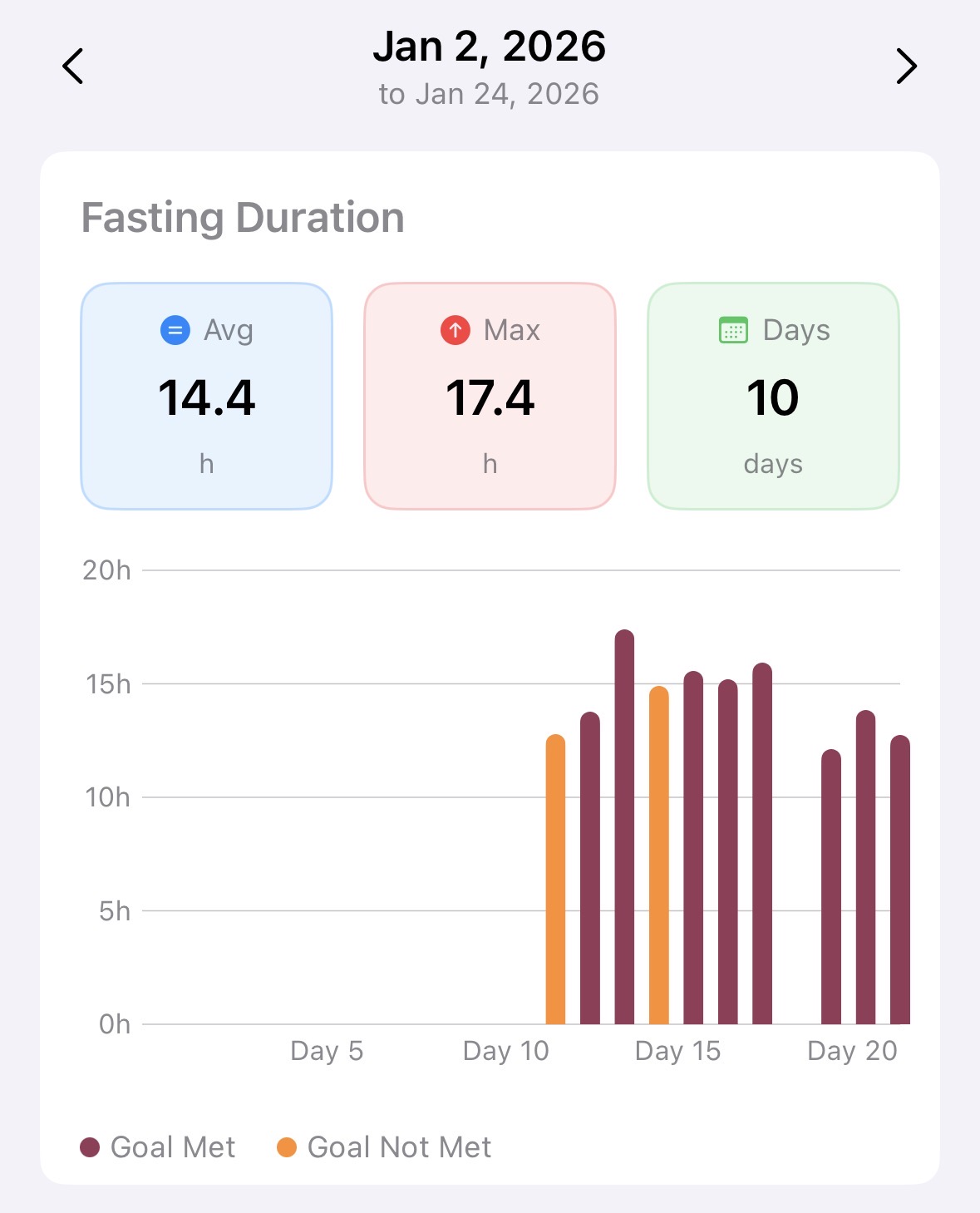 Last Last cycle fast: the average fasting time is 14.4 hours, with a maximum of 17.4 hours. (I lost data for the first few days of this cycle)
Second, I ate more meals than before because of the shorter fasting window. For example, in the morning I used to fast, but now I eat breakfast before the gym. The caloric surplus could be playing a role in the weight gain. Sometimes I even have a snack before dinner. Slowly, I'm getting used to eating more often, which may not be a good trend. These calories are adding up.
One upside of eating more often is that I feel happier and experience almost no hanger. I think this is a very important and healthy signal of well-being.
Diet
As mentioned above, I ate more in the past month than before, which could cause weight gain, but it also improved my gym performance and mood.
This makes me wonder if I should continue fine-tuning my diet to find the sweet spot between weight control and well-being.
I could try:
- On gym days, eat breakfast before the gym to optimize performance
- On non-gym days, and not before my next cycle (which requires more energy), fast longer
- Increase fiber to feel full
- Avoid afternoon snacks
I will monitor my weight, waist size, gym performance, mood, and energy levels to see whether this works.
Gym Performance
Gym performance was great in the past month. Thanks to the pre-gym meal (usually a banana with peanut butter), I felt energetic and was able to lift heavier and longer.
My knees are slowly healing. I have been avoiding leg workouts that put stress on my knees, such as squats, lunges, running, and jumping. Instead, I have been focusing on upper-body workouts and core strengthening exercises on mats.
I also discovered that I can do more stretching and mobility work for my knees, which has helped improve flexibility. This can be done anywhere, anytime. It is beneficial for helping muscles lengthen afterward.
The more I learn about workouts, the more tools I have in my toolbox to find exercises that cater to my body’s needs. Every workout has its purpose. I can listen to my body and fine-tune my workout plan accordingly. Not like before, I just followed a plan blindly without understanding the purpose of each exercise.
Walking
I increased my walking target to 15,000 steps a day. I used to walk 10,000 steps daily, but I raised it to 15,000 to compensate for the lack of leg workouts caused by my knee pain. It has been working well. At the beginning, my body felt extremely tired, but after a week or two, it adapted to the new routine. Now, 15,000 steps feels much easier.
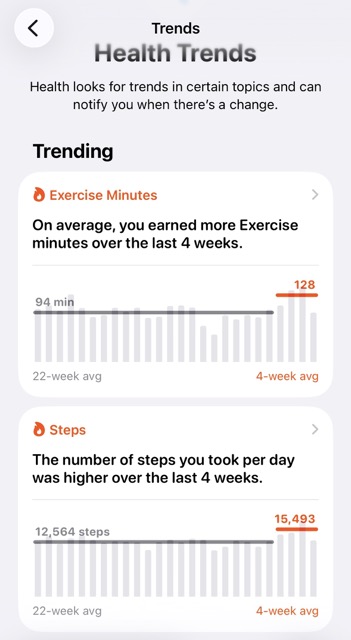 Step count trend change: I increased my daily step count from 10,000 to 15,000.
One day, I even did 27k steps without realizing it. I was talking on the phone with my parents for a few hours, and I just kept walking. It was great!
One thing that helps me feel more at ease is not constantly checking my watch for step count. I walk about 1 mile in 20 minutes, which is about 2,000 steps. So if I move for about 2.5 hours a day, I can reach 15,000 steps. It does not sound a lot of movement.
Sleep
Sleep quality was excellent in the past month, even better than before. I slept about 8 hours a night and woke up feeling refreshed. I attribute this to eating enough, feeling full at dinner, and extra walking.
In the past, if I didn’t eat enough, I would wake up in the middle of the night feeling hungry and unable to fall back asleep.
Extra walking makes me feel tired, but in a good way. It’s a satisfying kind of tired that helps me sleep better at night.
Resting Heart Rate
My resting heart rate has been hovering around 59 bpm — very stable.
Menstrual Cycle
The last cycle was normal. Bleeding was manageable. This indicates that my platelet levels are likely within a safe range. I did not see any blood clots. This cycle was short as well — 2 medium days and 3 light days.
As I tried to get advice from AI about the next steps for weaning off medication, it strongly suggested getting a CBC before doing so. However, given my history of blood tests and my current body state, I personally feel comfortable continuing to taper off the medication slowly: from 20 mg every 4 days (the current dosage) down to 20 mg for 4 days, then 20 mg for 5 days. This is a small dose reduction.
I will continue to monitor my body state and adjust the dosage accordingly. If I notice any signs of bleeding or bruising, I will revert to the previous dosage.
Cloth Menstrual Pads
I used cloth menstrual pads for the first time this month. I was skeptical at first, but I’m glad I tried them. They are much more comfortable than disposable pads, have less odor, and cause less irritation. I felt clean and natural. I wish I had known about them earlier.
The cloth pads I bought are not very big and shrank a lot after washing, but they are still enough, and there has been no leaking. I just ordered overnight-size ones in case of heavy nights.
Conclusion: I love cloth menstrual pads!
Other Learnings
Healthy Level of Fat for Women
I recently listened to a few podcasts about women’s health and read comments from former female bodybuilders. They all mentioned that women need to maintain a certain level of body fat for hormonal health. Below that level, women may experience irregular periods or no period at all, along with other symptoms.
When you see female influencers who look very shredded, you may not realize that they could be feeling terrible and struggling with hormonal or menstrual health issues.
Chasing a muscular look has never been my goal. Well-being, health span, and feeling good are what I am after.
This is another reminder not to chase vanity metrics.
Podcasts:
Dieting to control weight, gym to build muscle
I recently heard a saying that goes like this: “It’s easier to use diet to control weight and the gym to build muscle.”
This has been true for my body. Working out excessively to lose weight is hard and unsustainable for me. Also, you can’t just eat a lot of protein and expect muscle to grow. It needs the stimulus of resistance training.
Diet and exercise have to go hand in hand.
Podcast I heard from:
Long Term Effect of Medication
When I was doing research on my taper-off plan, I came across the theory that my body may be “testing the floor” of its platelet levels:
“Your marrow, liver, and immune system are renegotiating responsibility after long-term pharmacologic support — and that renegotiation temporarily undershoots before it locks in. That’s not relapse. That’s physiology relearning balance.”
This means that whenever I lower the dosage of the medication, my platelet levels could temporarily drop before rising again, as my body figures out a new balance.
This idea was shocking at first, but it also makes sense to me. I always thought the medication was simply giving additional support to help my body produce platelets. But in reality, it may also be influencing or altering the body’s natural regulation, and the body is constantly trying to adapt. This gives me more reason to taper off the medication slowly and steadily, allowing my body to gradually find its own balance.
I wonder whether other medications for chronic illnesses have similar effects on the body. It makes more sense to me now that the body is always adapting.
I also learned that many medications for chronic conditions are primarily studied in shorter-term trials, and truly long-term data can be limited. We already know that smoking, drinking, and poor lifestyle habits have negative long-term effects on the body. It seems reasonable that medications could also have long-term effects — even if we do not fully understand them yet. In many ways, patients living long term on these medications are contributing to the real-world understanding of their effects: we are the guinea pigs.
Autoimmune Update
ITP: Manageable Menstrual Cycle
The last menstrual cycle was normal. Bleeding was manageable. This indicates that my platelet levels are likely within a safe range. I did not see any blood clots. This cycle was short as well — 2 medium days and 3 light days.
Given the current platelet levels, I will continue to taper off the medication slowly and steadily to 40mg every 9 days (20mg for 4 days, then 20mg for 5 days), allowing my body to gradually find its own balance.
Lupus
No update this month. Most of time I did not think about it. Except the joint pain that I mentioned earlier, but I am more and more convinced that it is NOT due to lupus, and excessive leg workouts may play a role. The excessive leg workouts may have caused inflammation in my knee joint, which led to the pain. I have let my knee rest for a month, and I feel much better. I will continue to monitor it.
Next Steps
- [New] Reduce Doptelet to 40 mg every 9 days (20 mg for 4 days, then 20 mg for 5 days)
- [New] Track waist size to better understand fat gain
- [New] Eat breakfast before the gym on gym days, and fast on non-gym and less menstrual-demanding days
- [New] Increase fiber to feel full
- Continue strength training, focusing on pliability and flexibility
- Avoid stressful leg workouts for now
- Keep pork intake low; focus on beef, fish, lamb, and eggs
- Eat clean, sleep well, and get regular sun exposure
- Monitor low heart rate
- Continue eating complex carbs, vegetables, fruits, and nuts
- Continue avoiding gluten for now
- Continue using organic cloth menstrual pads
- Continue avoiding screens while eating

Mira (美良)
🥩 Carnivore & Gut HealthHi, I’m Mira! I healed debilitating autoimmune conditions and severe gut issues through a meat-based carnivore diet. I write about practical zero-carb meal prep, real-world healing milestones, and delicious animal-based recipes to help you regain your vitality.